
For parents, the school bus represents a daily moment of trust. They hand their child over to a driver and a vehicle they cannot see, on a route they cannot monitor, and wait until the child walks back through the door. For most of the journey, they have no visibility and no way to act if something goes wrong.
For school transport managers, the challenge runs in the opposite direction. They are responsible for dozens of buses, hundreds of students, multiple routes, and a schedule that has to run on time, every day, without incident.
Real-time school bus tracking addresses both sides of that equation. It gives parents visibility and gives transport managers operational control — through the same GPS telematics technology that fleet operators have relied on for years, applied specifically to the context of student safety.
What Parents Actually Need
When a school bus is late, a parent's first instinct is to call the school. The school calls the driver. The driver answers or does not. A conversation happens, information is relayed, and by the time the parent has an answer the bus has often already arrived.
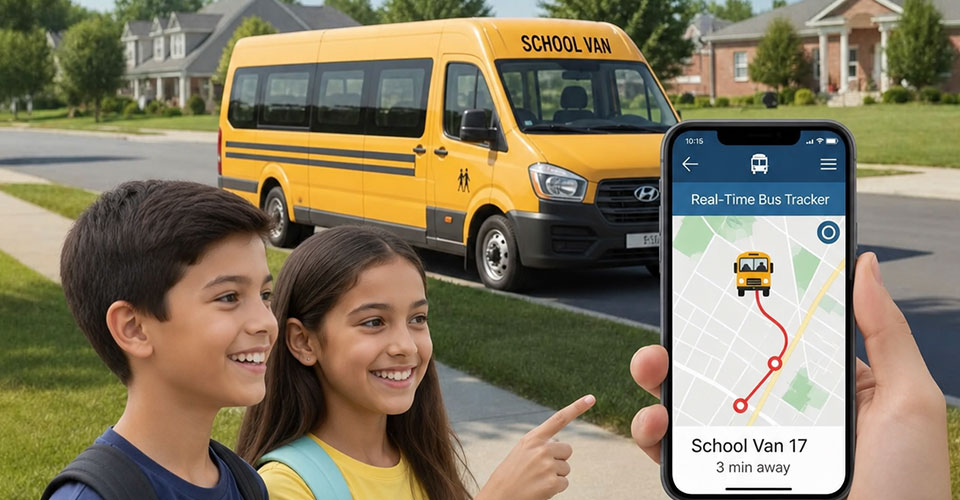
Real-time tracking replaces that chain of phone calls with direct, live visibility. A parent app shows the bus location on a map, updated continuously. Parents can see that the bus is two stops away, that it is running ten minutes behind schedule, or that it has already arrived at the school gate. They do not need to call anyone.
This is not a convenience feature. For parents of younger children, children with special needs, or students travelling long distances, it is a meaningful safety assurance that reduces anxiety and improves trust in the school transport service.
What Transport Managers Need
From the operations side, real-time tracking gives school transport managers visibility over their entire fleet simultaneously. Route adherence monitoring shows whether drivers are following assigned routes or making unscheduled deviations. Geofence alerts notify managers the moment a bus enters or exits a school campus, depot, or defined boundary.
Speed monitoring ensures drivers stay within safe limits, particularly on routes that pass through residential areas or school zones. Idle time tracking identifies buses that are sitting with the engine running unnecessarily, which matters both for fuel cost and for emissions near school premises.
Trip logs create a complete record of every journey, including departure time, arrival time, stops, speed profile, and route taken. This documentation is useful for incident investigations, parent disputes, and compliance reporting.
Driver Accountability and Safety Standards
School bus drivers carry a greater responsibility than most commercial drivers. The passengers they transport cannot advocate for themselves in the way adult passengers can, and the consequences of an accident or incident are particularly serious.
Real-time tracking creates a layer of accountability that supports safer driving. Drivers who know their speed, route, and behaviour are being monitored consistently tend to drive more carefully and follow assigned routes more reliably. This is not about distrust — it is about creating a system where safety standards are maintained through data rather than periodic spot checks.
Video telematics adds a further dimension. AI dashcams installed on school buses can monitor driver fatigue and distraction, capture footage of incidents, and provide evidence in the event of a complaint or insurance claim.
Emergency Response
In the event of an accident, breakdown, or security incident, GPS tracking provides the immediate location data that emergency responders need. Rather than relying on a driver to communicate their exact position under stress, the system provides precise coordinates automatically.
For schools that operate in areas with variable mobile coverage, the ability to locate a bus independently of driver communication is a critical safety backstop.
Building Trust Between Schools and Parents
Ultimately, real-time school bus tracking is as much about trust as it is about technology. Schools that provide parents with live tracking demonstrate a commitment to student safety that goes beyond words. That transparency builds confidence in the transport service, reduces the volume of anxious calls to school offices, and creates a safer, more accountable environment for students on every journey.
Dartlane Telematics delivers end-to-end telematics solutions for fleets, assets, and mobility businesses. Explore our GPS tracking, fleet management, and IoT sensor solutions.